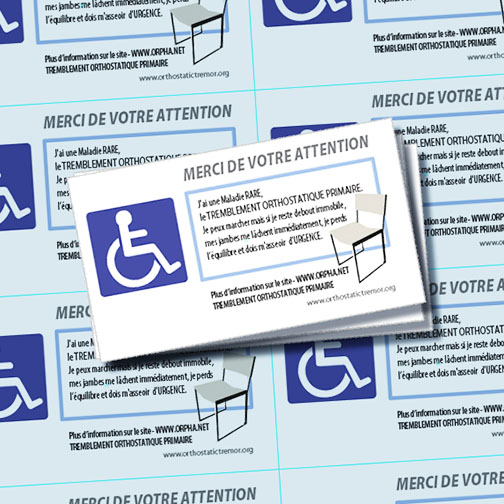
The administrators of the French Tremblement Orthostatique Groupe have translated their 3 articles on life with Orthostatic Tremor, to help build awareness. Thank you Claudia, Katia and Marie-Jo !
Below is the translation of the article about Claudia
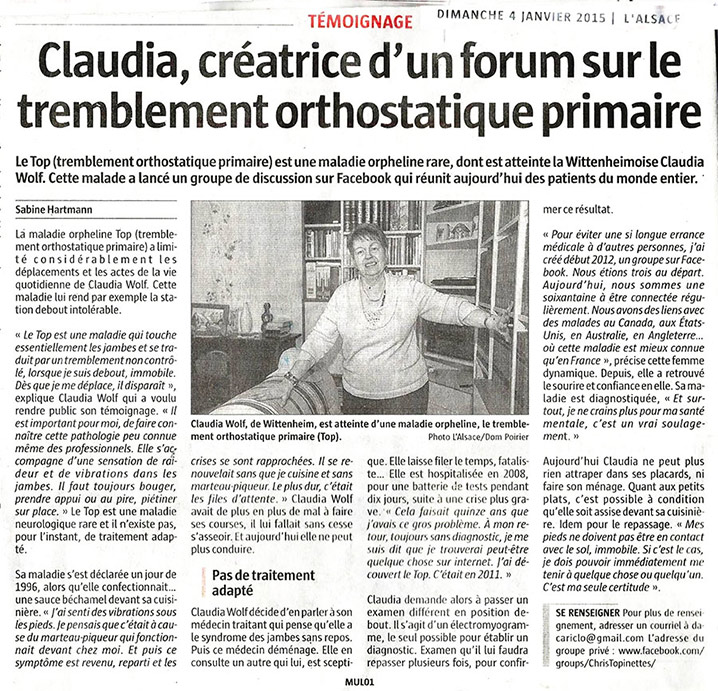
Claudia is the creator of an Orthostatic Tremor forum.
OT (orthostatic Tremor) is a rare orphan disease which affects Claudia Wolf, a Wittenheim resident. She launched a group discussion on Facebook which now brings together patients from the whole world.
By Sabine Hartmann
OT (Orthostatic Tremor) has greatly limited Claudia Wolf movement and everyday life. This illness makes standing upright intolerable.
“OT is a disease that primarily affects the legs and it causes an uncontrolled shaking whenever I am standing without moving. It disappears as soon as I start walking” explains Claudia Wolf who expressed the wish to testify publicly. “It is important for me to talk about this illness that even professionals know little about. It brings about a feeling of stiffness and vibrations in the legs. One has to be constantly on the move or to lean on something or at worst to stamp one’s feet.”
OT is a rare neurological disease which up to now has no appropriate treatment.
Her illness started one day in 1996 while she was cooking a bechamel sauce on her stove. “I felt vibrations under my feet. I thought it was due to the pneumatic drill that was being used in front of my house. But then this feeling started coming and going and the episodes happened at closer and closer intervals. They would occur even when I was not cooking and without any pneumatic drill being used. It was particularly tough when I was waiting in line.” Claudia Wolf was finding it more and more difficult to do her shopping. She had to sit down all the time.
NO APPROPRIATE TREATMENT
Claudia Wolf decided to speak to her doctor who thought she was suffering from restless leg syndrome. Then that particular doctor moved away. She consulted another one who seemed skeptical. With fatalism , she let time pass. In 2008 after an episode more serious than any other before, she was hospitalized for ten days and underwent a series of tests. “I had been suffering from this illness for 15 years by then. After I was released, still without a diagnosis, I thought that maybe I would find something on the internet. That’s how I discovered OT. That was in 2011.”
Claudia then had to undergo a further test while standing upright. This is the electromyogram test, the only test that can establish a diagnosis. She will have to take the test several times in order to confirm the diagnosis.
“In early 2012, I created a group discussion on Facebook so as to make sure others would not be misdiagnosed for such a long time. At the time there were three of us. Today, around 60 people visit the site on a regular basis. We are in contact with patients in the USA, Canada, Australia and Great Britain where this illness is better known than in France” this dynamic lady explains. Since then she has recovered her smile and her confidence. Her illness has been diagnosed. “And moreover, I no longer fear for my mental health, and that’s a huge relief.”
Today Claudia cannot reach for things in her cupboards, nor clean her house. As for cooking, she can do it as long as she is sitting in front of the stove. Same thing if she wants to iron clothes. “I cannot stand on my feet if I am not moving unless I immediately grab something or someone. This is my one certainty.
For more information send an e-mail to
dacariclo@gmail.com
The private group discussion address on Face book is:
http://www.facebook.com/groups/ChrisTopinettes/
 Below is the translation of the article about Katia:
OT a rare and invisible disease
For seven years Katia has been suffering from Orthostatic Tremor an illness little known of doctors.
When Katia Rémond, age 50, is sitting no one would guess she suffers from a rare disease. But when she is standing and not moving, waiting in a queue for instance, OT (Orhostatic Tremor) and the unsteadiness it brings about becomes obvious.
We are often sent to consult psychiatrists because people think we have a phobia.
“I thought it was no more than fatigue, I was feeling dizzy” she says, remembering the occurrence of her first symptoms seven years ago.
After a visit to her doctor, a neurological cause was mentioned but no name was offered: scans, MRI, all the tests came back normal. OT is so rare that it has no appropriate treatment and not many references.
Moreover, it can afflict men as well as women of all age groups. “I was diagnosed rapidly because of the tremors in my legs first and then in my lower back and sometimes even higher” but it is not always the case with everyone, this disease being mostly invisible. “Most doctors are not aware of it and they tell us to go and see psychiatrists thinking we suffer from a phobia or depression. Or they give us drugs that are not appropriate.”
(Caption under the picture) The illness is felt on a daily basis, Katia needs to lean on something to move around at home.
Mutual support
After she had to stop working as her job required her to stand and several years of misdiagnosis (but for some patients it takes much longer) she was finally able to put a name on her disease. “It was a great relief, I no longer felt isolated as if I were a space alien. She was able to carry out some research and find a group of people with the same disease. “We talk, we help each other to feel better and deal with the paperwork”
Katia invites all those who suffer from OT or who are likely to be suffering from it, to contact her (
katia.remond@orange.fr) or to join the group on Facebook (Tremblement orthostatique primaire)
 Below is the translated article about Marie-Jo:
MARIE JO BOUQUART :
I have OT
Marie-Jo Bouquard suffers from Orthostatic Tremor, also called OT, a rare illness she would like people to know more about.
Marie-Jo Bouquard looks slim and lively when we visit her in her house in Saint Vit, France where she enjoys a happy and seemingly very normal retirement. And yet she is fighting an almost invisible disease which slows down her every move, deprives her of normality and sets her apart the rest of the world.
“I could not stand with my feet close together, my friends thought it was funny because when standing my feet were always far apart. They felt it was the stance of a sailor’s wife, since my husband loves sailing.
That was in 1997, and they all finally got used to my way of firmly standing with my two feet apart.
Then I started feeling chronically unsteady whenever I was standing straight and not moving. “The feeling I was about to fall down would disappear as soon as I would start walking. Later I became unable to step on a stool, when I wanted to clean the windows for instance. I would put a foot on the stool but could not lift the other one.” Marie-Jo Bouquard consulted a first neurologist. But the MRI came out normal. He diagnosed anxiety, prescribed anxiolytics and recommended singing in a choir to calm her down. A second neurologist told her about the passage of time , the toll it took on one’s body and the need to accept what could not be changed. “I was exercising three times a week, I knew I was in good shape and I had no issue with my age.”
WHAT A BEAUTIFUL OT!
She was hesitant to take the antiepileptic drugs that where recommended to her. It took a third neurologist who was working in an office full of stuff, which forced his patients to step over or navigate the obstacles, to get the right diagnosis. “What a beautiful OT he exclaimed. He was not being cheeky and he immediately explained that I would not be pleased with what he was about to tell me” Marie- Jo Bouquard tells us. OT or shaky legs syndrome, was the illness that was poisoning my life. I was relieved to finally learn its name. I’d been wondering for more than ten years.”
OT is indeed a very rare abnormal tremor characterized by a fast shaking of the lower limbs and the trunk when one is standing. It also causes an intense and very uncomfortable feeling of unsteadiness and the fear of falling down although this never happens. Sitting down, walking or leaning on something makes it disappear the physician explained.
AN INVISIBLE HANDICAP
“I cannot clean the house, showering requires incredible energy, I cannot walk if the ground is not flat and cooking food standing in front of the stove has become torture. I used to throw parties but now I have no social life. After I’ve had the tremors, pain settles down in my back and shoots up all the way to my trapezius muscles.”
Today Marie-Jo Bouquard shares her experience on the internet and tells others what gives her relief. The efficacy of treatments varies from patient to patient. “There are about 50 of us who are known to have this disease in France, but I am certain that there are many who have not been diagnosed. This illness is not well known, there are even doctors who have never heard of it, and although we have stopped talking about orphan diseases to call them rare diseases many of us feel like orphans.”
To fight isolation and help research she is considering setting up an association and invites all those who have OT whether their diagnosis has been supported by an electromyogram test or not, to contact her at
jmjb@sfr.fr