1st International Orthostatic Tremor Meeting
Saturday, April 26, 2008 - Rochester, MN: Rochester MN 2008

( there will be a slight delay before the movie begins)
the following meeting notes from Pat :
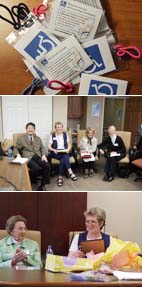
Attending: Helen (Toronto CAN), Mike (Spain), Lorie and husband (MN), Myrna and husband (MN); Betty and Paul (FL); Patty, (Alaska); Dorothy and two daughters (TX); Peggy and Gary(CAN); Gloria (NJ); Pat (NH); Beth and Jeff (NJ) and Dr. Matsumoto of the Mayo Clinic, Rochester, Movement Disorders Dept
Introduced by Peggy, Dr. Matsumoto observed that Orthostatic Tremor was first diagnosed in 1983 as “Shaky Leg Syndrome.”
Over the last 20 years, the Mayo Clinic Movement Disorders Dept. has seen 148 patients with OT. The doctors do not understand why walking dissipates the tremor and weakness/imbalance induced by standing.
“Gait Ignition Failure” is the name of the situation when someone with OT stands for so long they feel frozen in place and have difficulty moving again.
Dr. Matsumoto noted that no one has written about the toe cramping and leg cramping that many described. He also noted that the tremor is worse after any exertion.
OT is progressive (about 70% of patients say it has worsened) and Dr. Matsumoto explained that depression happens in 70% of cases. Interestingly, only15% of people with OT actually fall. 30% of patients are told that their condition is psychological and it takes an average of six years to obtain a correct diagnosis.
Gloria offered that the OT website has heard from people in 28 countries.
Dr. M observed that inheriting OT is also rare and that only 2 of the 148 people in the Wilkinson study could substantiate inheriting the disorder.
The onset is usually at age 50 or later and the most common associated disease is Parkinsons (10% of the 148).
Dr. M. urged everyone who has OT to have a brain scan (MRI) as a baseline. He went on to say that most studies suggest the tremor comes from the cerebellum and that it could be the result of brain chemicals out of balance (dopamine or GABA?)
After spinal cord simulation, patients felt better but the tremor remained the same. Dr. M. said he would look into peripheral nerve damage.
When asked about deep brain stimulation (and Gamma Knife Thalamotomy), Dr. M. said there were not enough examples (two that he knew of) and that the procedure wasn’t accurate enough to be safe.
Research
Imaging studies to find tremor source or chemicals -- EEG studies currently underway at Mayo/Rochester to identify electric signals and to determine exactly where OT originates in the brain
Mayo/Rochester sees about 15 new OT patients a year
No drug studies as of yet
Most likely track for research is NIH and the International Tremor Foundation
Essential Tremor has been treated with electric stimulus to the thalamus by implanting wires and continuing the stimulus indefinitely (like a pacemaker)
Gamma Knife Thalamotomy burns a hole (using radiation) but is not accurate enough for Dr. M. to consider it safe.
Adrenaline and cortisone/epinephrine are factors in OT
Docs don’t know if stress causes OT, but stress is certainly present and exacerbates the symptoms
Deep breathing helps
To launch new research would take a minimum of $100,000
Some work being done in London, at Columbia-Presbyterian, Mayo/Scottsdale
To donate one’s body for medical research, check with a patient registry
To Raise Awareness
Mayo could hold a movement disorder conference for other medical professionals
Have a neurologist publish an article in Neurology Today
Website since 2000, initiated by Gloria Nelson
Guest spot on Oprah, ask about applying for Oprah’s Big Gift
Wilkinson study results at Mayo/Rochester will be published at completion
Group Discussion – Afternoon Session
Join NORD
We would need to raise $35,000
Donations
On-line giving
Special events individuals and groups might organize
NORD has a Medical Advisory Committee to review RFPs and award a research grant
OT will need to become a 501(C)(3) nonprofit (Pat will get this process started)
Plan an “informal” meeting next year and a formal meeting every other year?
To Be Determined
Name of the new nonprofit OT organization
Mission statement
Vision statement
Do we offer membership to this nonprofit org
Elect or appoint Board of Trustees
How often to meet
Draft Bylaws
Develop case statement
Develop fund raising campaign for website
Have DONATE NOW button on OT website connect directly to NORD